
For most of my career, the first meaningful participant in a technology buying decision was human.
Across AI infrastructure, cloud, and developer platforms at Together AI, Google Cloud, DigitalOcean, Oracle, and Vultr, I watched a familiar journey repeat itself. A developer encountered a problem. An architect framed the requirements. Someone searched for options, read documentation, asked peers, tried a quickstart, and brought a recommendation into the organization.
The marketer's job was to influence that human journey: earn awareness, explain the category, make the differentiation clear, build developer trust, and equip an internal champion to carry the story forward.
That journey now has a new beginning.
A developer can ask an agent:
Design the stack for this application. Compare the credible options. Account for our language, scale, security requirements, and cloud environment. Then build the first version.
The agent can search the web, retrieve documentation, inspect repositories, compare APIs, select a package or service, generate configuration, write code, and test the result.
The agent does not sign the contract. It does not own the budget. It does not accept accountability for the architecture.
But it may determine which vendors make the shortlist, how their strengths and weaknesses are framed, and which one becomes the working default.
Coding agents now lead the technology buying committee.
Developer marketing will never be the same.
“Lead” does not mean decide. It means go first.
The claim is intentionally provocative, but the distinction matters. Coding agents do not lead by authority. They increasingly lead by sequence: entering the market first, framing the options, and turning a recommendation into a working default before the rest of the committee convenes.
Agents are not replacing engineering leaders, security teams, procurement, finance, legal, or executive sponsors. Most are not autonomous economic buyers. Agent adoption is also uneven. The 2025 Stack Overflow Developer Survey found that 52% of developers either did not use agents or stayed with simpler AI tools, while 38% had no plans to adopt them.
But the same research shows the direction of travel. Eighty-four percent of respondents were using or planning to use AI tools in development, and 51% of professional developers used them daily. Among developers using agents at work, 84% used them for software development. Separately, 48% of developers said they had endorsed or influenced a technology purchase during the preceding year.
The people who influence technology purchases are increasingly delegating parts of discovery, evaluation, and implementation to AI systems.
Research from Anthropic makes the emerging division of labor especially clear. In an analysis of roughly 400,000 Claude Code sessions between October 2025 and April 2026, people made most of the planning decisions while Claude made most of the execution decisions. Usage also shifted toward more end-to-end work, including deploying and running code.
Humans are still deciding what they want to accomplish. Agents are increasingly deciding how.
In technology markets, the “how” is where vendors get selected.
That is how an agent can lead without making the final decision. It leads chronologically: the initial question may be posed to an agent before a colleague or vendor. It leads in framing: the agent can define the category, alternatives, and evaluation criteria. And it leads in implementation: its recommendation can become code before the broader organization knows a choice has been made.
The agent is not the authority. It is the consideration broker.
And because it operates upstream of the visible buying process, it can become one of the most consequential participants in it.
The shortlist may now be formed inside the terminal
Developer marketing has always been different from other forms of B2B marketing because the buyer can experience the product before the company experiences the sales process.
A developer can adopt an open-source project, call an API, install a package, or provision a cloud service without filling out a form or speaking to a representative. Product experience is part of the marketing. Documentation is part of the marketing. The quality of the SDK is part of the marketing.
Agents collapse this journey even further.
A search engine returned links. An analyst produced a report. A peer made a recommendation. Each influenced the decision, but a person still had to convert that influence into action.
An agent can move from question to recommendation to implementation in one working session:
- Interpret the technical job.
- Assemble a consideration set.
- Compare the options against the stated constraints.
- Select an approach.
- Write the import statement, API call, configuration file, or deployment manifest.
- Test whether it works.
The change becomes clearer when the two journeys are placed side by side:
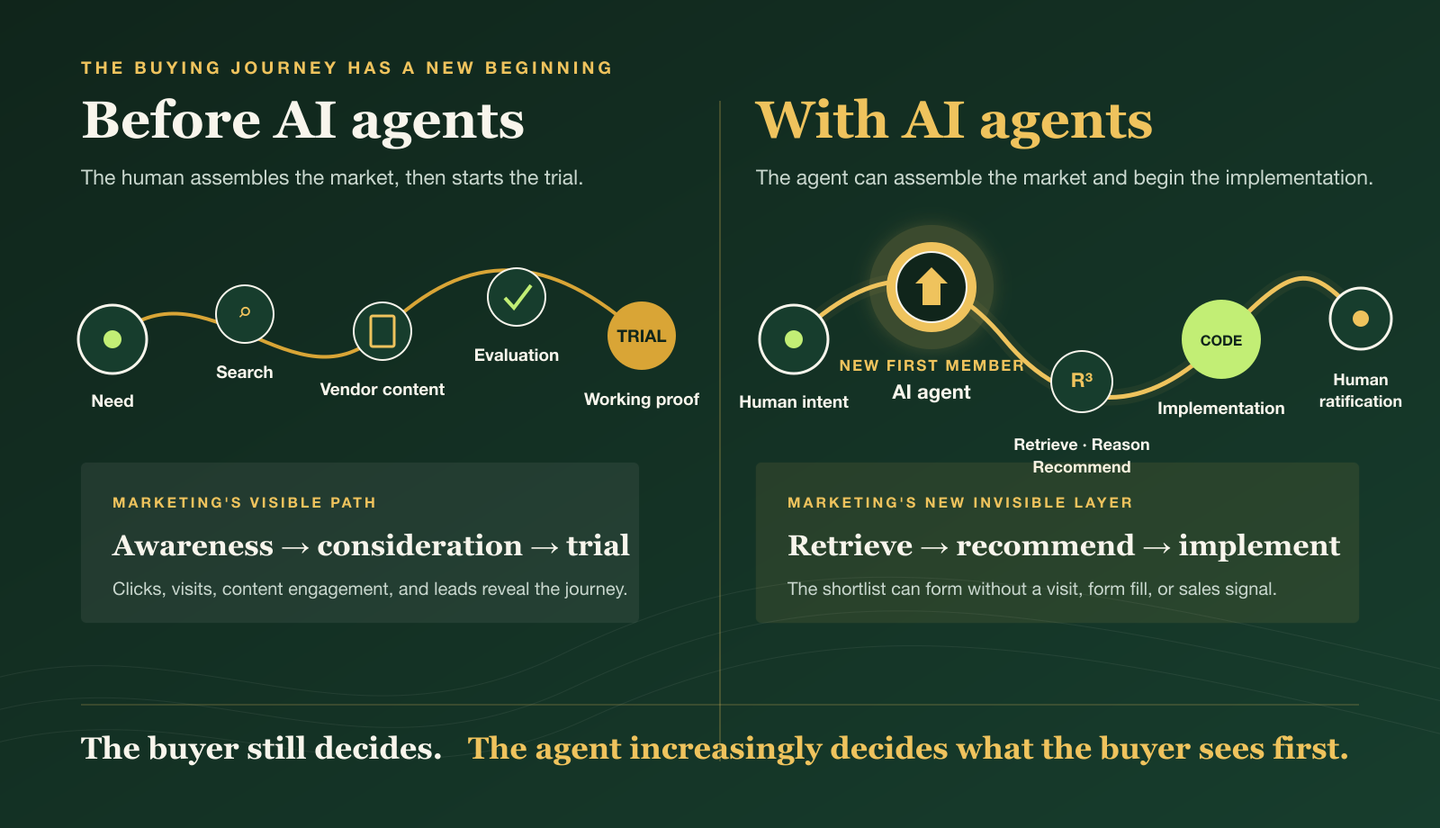
The buyer still decides. The agent increasingly decides what the buyer sees—and may begin using—first.
The difference is not cosmetic. Implementation creates path dependence.
A service provisioned for a prototype, a library added to the repository, or a data model embedded in the application becomes harder to displace than a logo on a comparison slide. The agent's initial choice may be provisional, but it creates a working default that the human team must actively decide to replace.
By the time a lead appears in the CRM, a webinar attendee raises a hand, or a sales conversation begins, the most important early decision may already have happened inside an IDE, terminal, or agent thread.
That is the new reality developer marketing has to address.
The agent experiences your market as context
An agent does not understand a technology market the way an experienced architect does. It constructs an answer from the context available to it: model training, live search, documentation, repositories, package metadata, code examples, public issues, third-party discussion, tool descriptions, and whatever the user or company supplies.
For marketers, that context is becoming a new market surface.
The Model Context Protocol, for example, gives AI applications a standard way to connect with external data, tools, and workflows. MCP tools are designed so models can discover and invoke them based on the user's request. By May 2026, Microsoft was making official articles and code samples available directly to coding agents through the Microsoft Learn MCP Server.
Consider what that means. Documentation is no longer only a destination a developer visits. It can be a live source an agent consults while deciding what to recommend and how to implement it.
Search is changing in parallel. Google says its generative search experiences use retrieval and “query fan-out”—issuing multiple related searches to construct a response—and has introduced dedicated reporting for visibility in generative AI search features. The information journey is moving from a sequence of human clicks toward a machine-assembled answer.
The agent's understanding of your product may therefore be assembled without following the journey your website was designed to create. It can extract a claim from one page, a limitation from the docs, an implementation pattern from GitHub, a pricing assumption from a forum, and a comparison from a third party—then compress all of it into one recommendation.
This is the new machine consideration layer: the upstream environment in which an agent interprets the job, assembles the market, compares the options, and may begin acting on the answer.
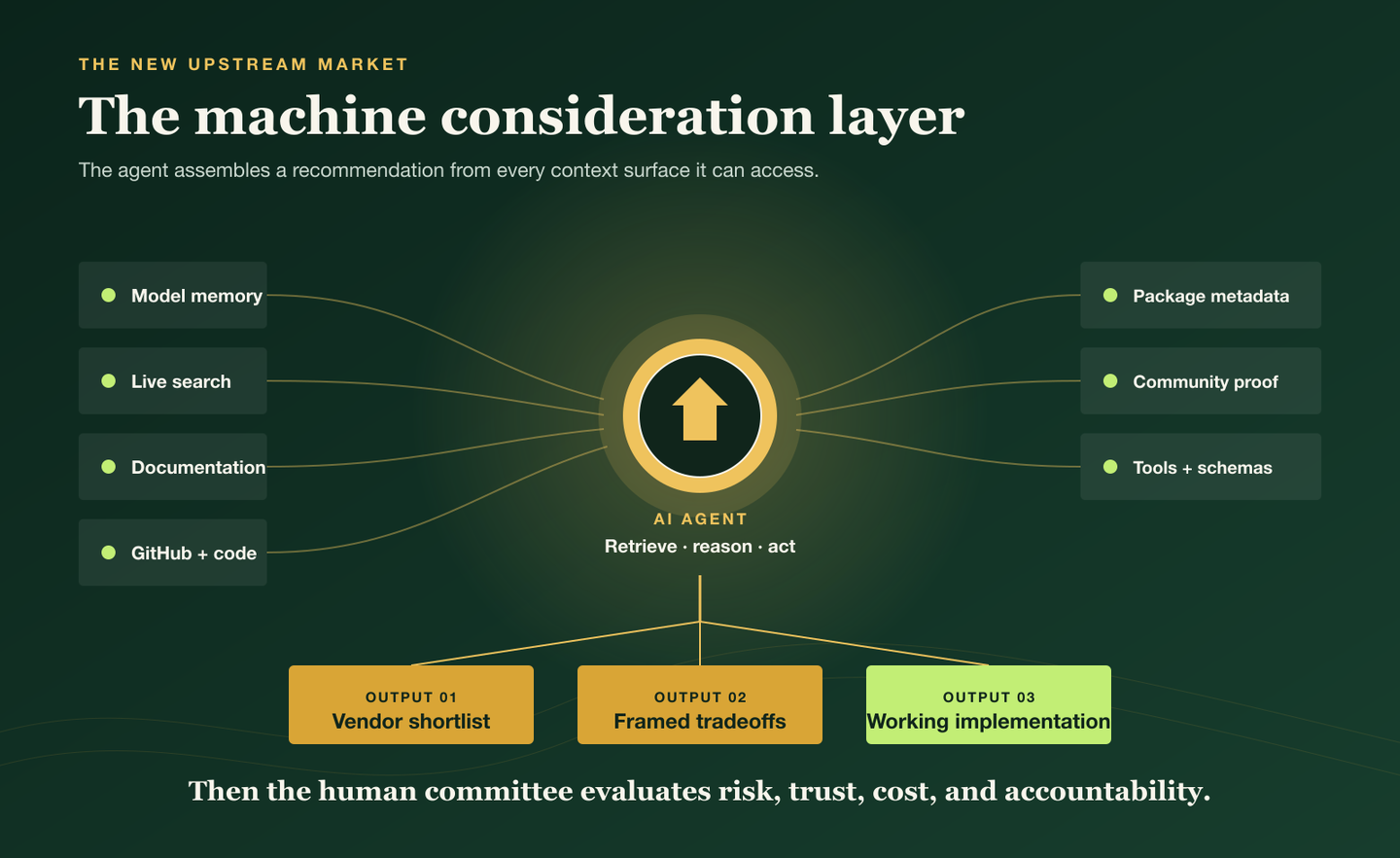
The agent experiences the market as context. The human committee still evaluates risk, trust, cost, and accountability.
Developer marketing now has to perform inside that layer.
The resulting mandate can be understood as six connected jobs: make the product easy to understand, verify, execute, fit, encounter, and evaluate.
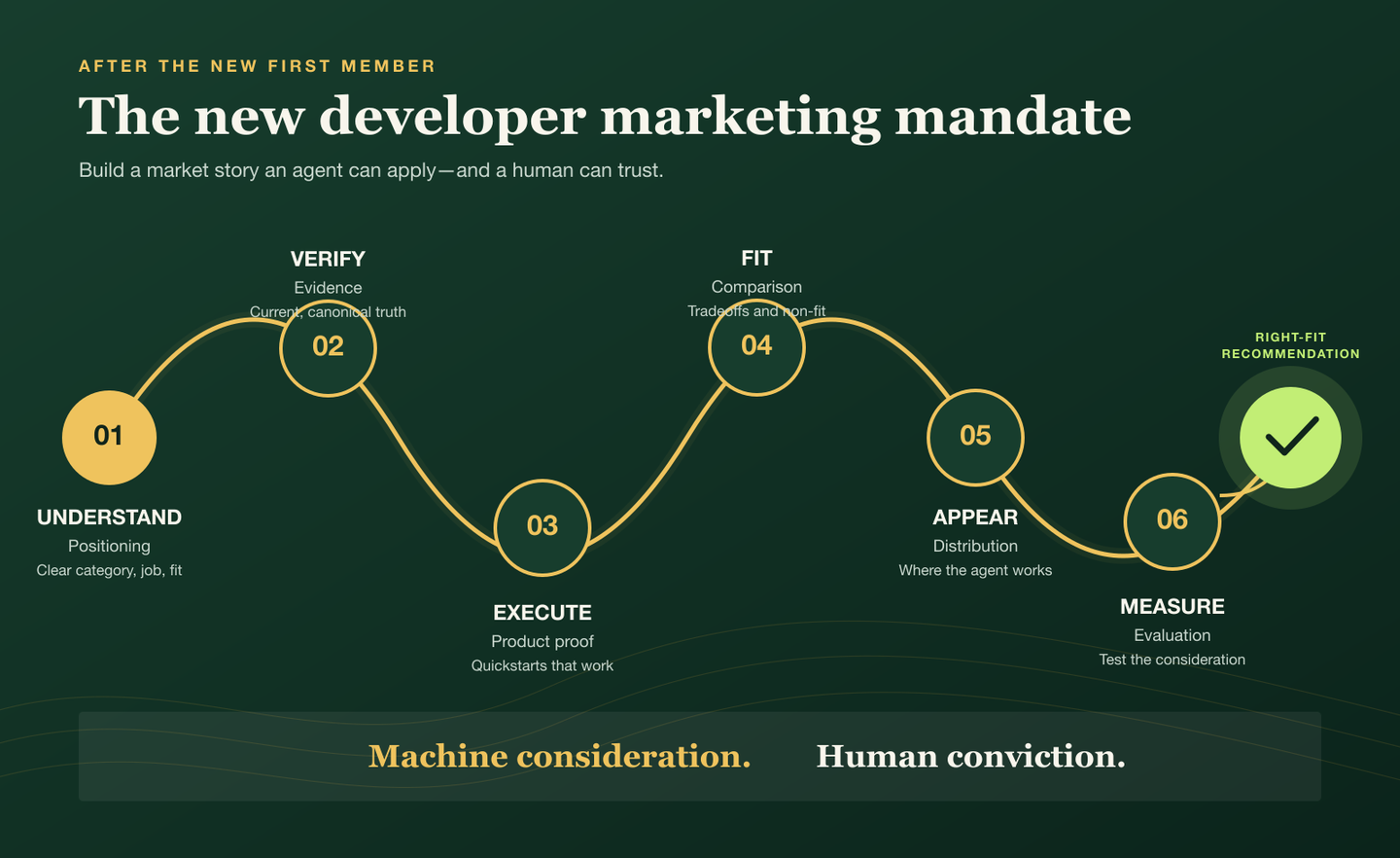
The destination is not maximum agent visibility. It is a right-fit recommendation that earns machine consideration and human conviction.
Developer marketing must make the product easy to understand correctly
The first implication is positioning.
Agents compress information. If a product's position depends on atmosphere, invented language, or interchangeable claims, the compression will be unkind. “The intelligent platform for modern innovation” gives a system almost nothing useful to match against a technical requirement.
An agent needs to establish:
- What is the product?
- What job is it designed to do?
- Who is it for?
- Which environments, languages, and architectures does it support?
- What does it replace, complement, or depend on?
- When is it a strong choice?
- When is it not the right choice?
- What tradeoff does a buyer accept in exchange for its advantage?
This does not mean flattening the brand into robotic prose. It means building semantic precision beneath the brand.
The strongest market story now has to work at two resolutions: memorable enough for a person to repeat and specific enough for an agent to apply.
Developer marketing must make the truth easy to verify
The second implication is evidence.
An agent cannot reliably recommend what it cannot reliably establish. Factual consistency across the website, documentation, pricing pages, release notes, repositories, security materials, and partner listings is no longer operational hygiene. It is a go-to-market advantage.
Conflicting limits, abandoned pages, undated benchmarks, broken examples, and vague deployment claims create uncertainty. In a high-stakes technical decision, uncertainty favors the option with clearer evidence.
The canonical truth must include the uncomfortable details: prerequisites, constraints, migration considerations, pricing mechanics, regional availability, version-specific behavior, and situations where the product is not the best fit.
This is especially important because trust has not kept pace with AI adoption. In the Stack Overflow survey, more developers actively distrusted the accuracy of AI tools than trusted it. An agent recommendation still needs to survive human verification.
The winning vendor will not merely be mentioned. It will be easy to check.
Developer marketing must make the proof executable
The third implication is product experience.
Developers in the Stack Overflow survey ranked an easy-to-use API, a robust API, product quality, and reliability above brand image when deciding which technologies to endorse. Agents encounter those qualities through concrete artifacts:
- well-maintained SDKs;
- accurate API specifications;
- tested quickstarts;
- realistic example repositories;
- clear authentication and error behavior;
- reproducible benchmarks with disclosed methodology;
- migration guides;
- infrastructure-as-code modules;
- examples aligned with current product versions.
The best claim may no longer be the one an agent can quote. It may be the one the agent can successfully run.
This makes the traditional boundaries between product marketing, developer relations, documentation, and product engineering increasingly artificial. The quickstart is messaging. The API design is distribution. The sample application is proof. A failed install is a broken brand promise.
When the participant leading the buying journey can write and test code, developer marketing must be able to meet it with working evidence.
Developer marketing must show where the product fits—and where it does not
The fourth implication is comparative clarity.
Technical buyers rarely ask which platform is universally best. They ask what is best for a particular workload, team, architecture, stage, risk profile, and set of constraints. Agents do the same.
Vendors need credible answers to the questions that actually determine a recommendation:
- When should I use this instead of the obvious alternative?
- When should I use both?
- What changes at a particular scale or level of operational maturity?
- What will migration require?
- Which workloads are a poor fit?
- Which advantage matters enough to justify the tradeoff?
This is not a license to generate thousands of shallow “X versus Y” pages. Commodity content creates little evidence and even less trust. A smaller number of technically credible, maintained, and appropriately qualified comparisons will do more for human and machine understanding than a programmatic landfill of competitor names.
Fit is more valuable than forced inclusion. An agent that recommends the product for the wrong workload can create a failed implementation, support cost, and a vocal detractor. The goal is not to appear in every answer. It is to appear in the right answers for the right reasons.
Developer marketing must go where the agent works
The fifth implication is distribution.
The website remains essential, but it is no longer the entire market surface. For developer platforms, presence increasingly includes documentation indexes, GitHub, package registries, IDEs, cloud marketplaces, templates, integration catalogs, agent skills, and—where it serves a real user need—protocols such as MCP.
Not every company needs an MCP server. Publishing an `llms.txt` file is not a strategy; Google explicitly says it does not use `llms.txt` for generative Search. Different agents obtain context through different mechanisms.
The durable question is:
Where does an agent working on the customer's job obtain trusted context and capabilities, and is your product legible there?
Sometimes the answer will be excellent public documentation. Sometimes it will be a maintained integration, an official docs endpoint, a machine-readable API, an agent skill, or a callable tool. The right surface is determined by the customer's work—not by whichever protocol currently attracts the most attention.
Developer marketing must measure consideration it cannot see
The final implication is measurement.
Traditional share of search, web analytics, and lead attribution reveal only part of the agent-mediated journey. Cloudflare's 2025 data showed that leading AI platforms often crawled vastly more pages than they returned as referral visits. Crawl activity is not buyer intent, but the crawl-to-referral gap illustrates the problem: information can shape a generated answer without producing a familiar clickstream.
Developer marketers need a new form of market research: repeatable evaluation of the questions customers ask agents.
Build a test set around real jobs, workloads, architectures, constraints, and buyer situations. Run it across the assistants and coding agents that matter to the audience, with and without live retrieval. Then evaluate:
- Was the product included when it should have been?
- Was it categorized correctly?
- Did the agent understand its strongest-fit and weakest-fit use cases?
- Were important facts accurate and current?
- Which sources shaped the answer?
- Were meaningful tradeoffs preserved?
- Could the agent implement the recommended path successfully?
- Did it recommend the product where it should not have?
Do not treat the result as a deterministic ranking. Agent outputs vary by model, context, tools, user, and time. Treat it as a research instrument—a way to find gaps in positioning, evidence, documentation, distribution, and product experience.
Clicks once revealed much of the path to consideration. Increasingly, marketers will have to test the consideration itself.
This is not “marketing to robots”
Every new channel attracts shortcuts. Most will age badly.
Do not rewrite the website in flat, robotic prose. Do not surround every possible prompt with low-value pages. Do not manufacture community mentions or seed claims that cannot be substantiated. Do not assume one metadata file will make every model understand the business. Do not optimize for one snapshot from one assistant. And do not expose powerful agent tools without appropriate permissions, authentication, observability, and human control.
Most importantly, do not abandon the human audience.
Agents may shape the shortlist, but people still evaluate strategic risk, trust the team behind the product, defend the choice internally, negotiate the relationship, and live with the result.
Marketing must make the product legible to machines because it is trying to serve humans well—not because machines are a new audience to manipulate.
A new mandate for developer marketing
Building FrontierGTM's own specialized GTM agents has reinforced this lesson from the other side: an agent's output is only as good as the job it is given, the evidence it can access, the context it can interpret, and the controls around what it can do.
Technology products now face the same reality in the market.
This transition is central to the work I am building at FrontierGTM. AI, infrastructure, and developer-platform companies need a GTM system in which positioning, technical proof, public evidence, and agent workflows reinforce one another. The same shift changing who interprets and recommends the product is changing how marketers research the market, make decisions, and execute the work.
Agents increasingly belong on both sides of the equation. Human judgment remains the governing layer.
Coding agents now lead the technology buying committee into the market. That changes the job of every marketer responsible for a developer platform, cloud service, database, security product, API, AI platform, or piece of infrastructure.
The winners will not be the companies that find a clever way to make an agent mention their brand more often. They will be the companies that become easiest to understand correctly, easiest to verify independently, easiest to try successfully, and safest to recommend in the right context.
Developer marketing now has to earn two things at once:
Machine consideration. Human conviction.
The first gets the product into the decision.
The second gets the decision made.
Ryan Pollock is the founder of FrontierGTM, a forward-deployed GTM firm for companies building at the AI and technical-infrastructure frontier. His experience spans Together AI, Google Cloud, DigitalOcean, Oracle, and Vultr.
Sources and further reading
- Stack Overflow Developer Survey 2025: AI
- Stack Overflow Developer Survey 2025: Technology purchases
- Anthropic: How Claude Code is used in practice
- Model Context Protocol: Introduction
- Model Context Protocol: Tools
- Microsoft Learn MCP Server
- Google: Optimizing for generative AI features
- Google: Generative AI performance reports in Search Console
- Cloudflare Radar 2025 Year in Review